Objective
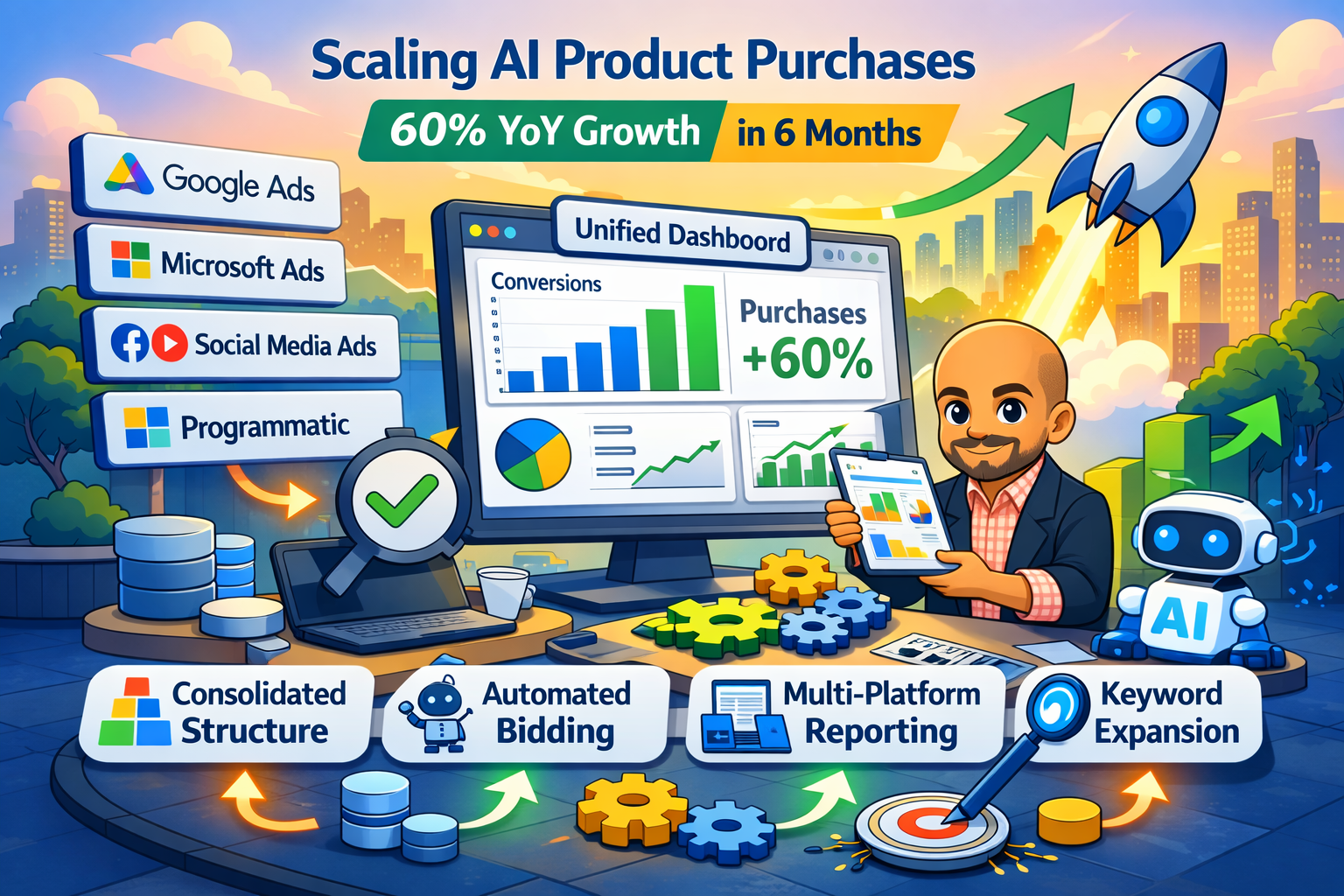
To scale purchases for a high-growth AI product over a 6-month period while improving efficiency and building a sustainable performance marketing engine.
Duration
6 Months
Platforms Involved
- Google Ads
- Microsoft Advertising
- Paid Social (Meta, LinkedIn, others)
- Programmatic Channels (DV360 and open exchange inventory)
The Challenge
The AI product was operating in a competitive and rapidly evolving category. While performance marketing campaigns were active across multiple platforms, the account structure had become fragmented over time. Key issues included:
- Over-segmentation leading to data dilution
- Manual bidding strategies limiting scale
- Siloed reporting across platforms
- Untapped keyword expansion opportunities
The core challenge: drive aggressive purchase growth without compromising efficiency.
Strategy & Execution
1. Structural Consolidation Across Platforms
We restructured campaigns across search, social, and programmatic channels to:
- Reduce unnecessary fragmentation
- Consolidate ad groups and campaigns to improve signal density
- Align campaign objectives directly to purchase conversion events
- Standardize naming conventions for cross-platform clarity
This enabled stronger machine learning signals and improved optimization velocity.
2. Implementation of Automated Bid Strategies
Manual bidding was replaced with advanced automated bidding strategies:
- Target CPA and Maximize Conversions on search platforms
- Value-based optimization where possible
- Conversion signal refinement to prioritize high-intent users
By feeding cleaner, consolidated data into platform algorithms, we unlocked better auction-time optimization and improved conversion rates at scale.
3. Consolidated & Automated Multi-Platform Reporting
We built a unified performance dashboard using Looker Studio to:
- Integrate data from Google Ads, Microsoft Ads, social, and programmatic
- Standardize KPIs across platforms
- Automate reporting workflows
- Enable real-time visibility into purchase performance
This eliminated manual reporting overhead and significantly improved decision-making speed.
4. Expansion into New Keyword Verticals
After stabilizing core performance, we focused on strategic expansion:
- Mining search term reports for high-intent long-tail keywords
- Identifying emerging AI-related queries
- Competitor conquesting campaigns
- Testing broader thematic keyword clusters
This expansion allowed us to scale volume while maintaining conversion efficiency.
Results
Over a 6-month period:
- 60% Year-over-Year growth in purchases
- Improved conversion efficiency due to structural and bidding enhancements
- Faster optimization cycles through consolidated reporting
- Increased impression share in high-intent keyword categories
The growth was not driven by incremental budget alone, but by building a more intelligent and scalable acquisition framework.
Key Takeaways
- Structural simplification strengthens machine learning performance.
- Automated bidding performs best when fed with clean, consolidated signals.
- Unified reporting is critical for cross-platform optimization.
- Strategic keyword expansion fuels sustainable scale in competitive AI markets.
If you're looking to scale an AI or SaaS product through performance marketing, building the right structure and data foundation is often more powerful than simply increasing spend.